Cosleeping saved my baby: a story of mum survival and finding a solution that suited our family
- Aug 11, 2025
- 11 min read
Note: the contents of this article are the opinion of a local mother and are not to be taken as health care directives for you or your family. Cosleeping is currently against general medical advice because it can be dangerous when done improperly and it is difficult to meet the conditions for safe cosleeping. Please use your judgement for what is right for your family.
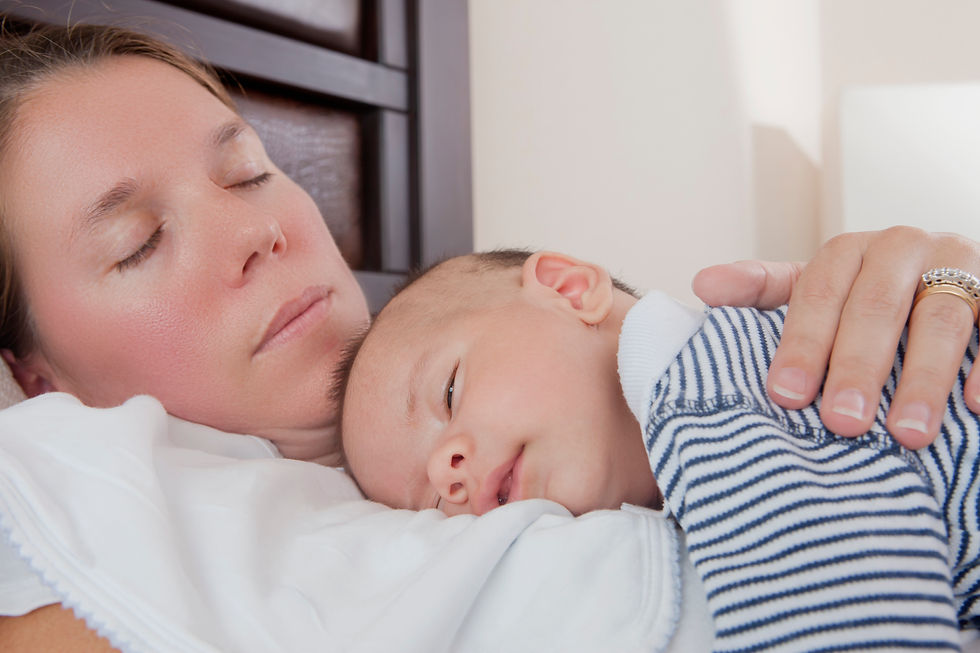
Becoming a mother is by far the best thing I have ever done.
Nothing has ever been so rewarding, or meaningful. However, while being the most valuable and joyous experience I have ever had it is simultaneously the most challenging, difficult time. Some of the struggle is inevitable. I was warned about the trauma of birth, and the exhaustion. What frustrates me looking back on my experience is the difficulties that could have been avoided if our society was different. There are so many points I could explore on this, the feeling that mothers are not respected or valued sufficiently enough to help us do the most important job on earth, the cultural isolation that shifts young parents to breaking point, and so many more musings. For this article, however, I would like to point out something that will inevitably be controversial and is likely to irritate many, but nonetheless is speaking the truth about my experience (and very likely the experience of others). I want to talk about how our medical system, built by people who sincerely care about humanity, is nonetheless failing young parents and our babies on one crucial point. I will elaborate on this after telling my story so before anyone gets too offended, you can see why I feel this way and on what point I think services need to do better.
Matrescence
I went into parenting with practically no experience with babies. I was the youngest in a nuclear family, I had no cousins, and the friend I had who had babies never asked me to get involved with baby care in any meaningful way. I guess she thought, as the mother, she had to do it all alone and only lean on family when help wasrequired. I didn't think anything of this, something I now regret. If I had any concept of how difficult child rearing was back then, I would have offered to be more present and useful. I was completely unaware and had some ignorant notion that babies were just like those seen on television; cute creatures that mostly stayed silently in the background as additions to the family unit, who occasionally cried irrationally (so many TV babies cannot be soothed and are seen as babies just crying because that's a baby behaviour). What a surprise when I realised I couldn't squash my babies daily life conveniently into my own lifestyle. They wouldn't sit silent while I went about doing every thing I did pre motherhood. They needed, not wanted, but psychologically and physically needed every ounce of attention and energy I had in me. I also found out crying wasn't just a baby behaviour, it was all about communication and all crying deserved to be taken seriously (although the misconception I had about this was very damaging, as you will see). I abandoned all my hobbies and pushed paid work off further than I thought I would. They became the centre of my universe, and TV shows no longer represented family life (they didn't even come close. I can't think of a single movie/ show that represents breastfeeding or sleeping in the same room that I started out with). I changed as a person, and my whole perception on life changed too. Taking care of my baby became my top priority above all else. I finally understood what it meant to want to give your entire self to another, to genuinely sacrifice. It's a good thing our brains transform through matrescence (see 'Matrescence: on the metamorphosis of pregnancy, childbirth and motherhood' by Lucy Jones for more information about how mothers change physiologically and psychologically during pregnancy in a fundamental way as we move into the next stage of our life cycle), babies are so immature and so hugely dependent on us it is essential to give them our whole hearts to raise them. The problem was I started with a twisted, false view based on shows that misrepresented infants. This meant I had to lean on information presented to me from other sources, and the information given to me by medical professionals was incomplete and misguiding on one crucial aspect: sleep.
When my first baby was born, I expected they would sleep soundly in the bassinet. TV babies slept in a crib in their own room, and the information provided to me by the hospital said they should sleep in their own space in the same room for at least six months. The midwife told me if they didn't settle in the bassinet, I should just give them a bath, hold them for about half an hour when they were in a deep sleep and transfer them. If they woke, repeat the cycle. "I've never known anyone who had to do it more than three times" she promised. I don't remember how many times I tried this but I definitely went over three. This was not the only trick that failed, and I tried many based off the advice of midwives and family members. The issue wasn't to get them to sleep, they slept soundly in my arms. Keeping them sleeping in the bassinet was the thing that wouldn't work. They would wake up after the transfer, without fail. I lost count of the nights I gave up after who knows how many cycles of soothing to sleep, holding them in my arms (for a minimum half an hour, often an hour) to reach that sweet deep sleep and then boom, crying wakeful baby. It was my amazing partner who helped us survive those first three months of chronic sleep deprivation, overwhelm and feeling fundamentally broken. He held the baby when I couldn't anymore. I remember telling him a few times 'leave them to cry, they need to learn to sleep in the bassinet. That's what all babies do.' I will always be grateful to him for ignoring me and holding them, lying them on his lap facing the ceiling. He was exhausted too but he let them drift back to sleep in the sweet embrace of skin to skin contact, cradled on his legs, watching them without sleeping himself. I was able to submit to sleep while he held them safely supervised. How privileged I feel to have such a great partner.
Sleep Deprivation is Dangerous
The sleep deprivation was dangerous. I almost fell asleep holding them on the nursing chair once. My partner talked me into consciousness so I didn't drop them, but this clearly couldn't be sustained. In the end, they wound up in our bed. Because I didn't know anything about cosleeping, it was initially not done in the most safe way possible. I am so fortunate nothing happened, but it was the best sleep I ever got (not to mention the best sleep the baby got!) I felt so guilty about it though, I believed it was unsafe under all circumstances and I was a horrible mother.
At around the four month mark, my partner had to go away for a month for work. For a week or so to this point, I had gone through nightly cycles of getting baby to sleep, holding onto them for an hour, transferring to the bassinet, them waking, repeat several times, giving up and cosleeping. When he was absent I felt so guilty about cosleeping I became adamant I wouldn't do it again. This brought me to a whole night of not sleeping a single minute... the whole night was settle baby, hold, transfer, they woke up, repeat. When the sun rose I called my mother in tears. She needed to hold the baby, I had to sleep... the next night in desperation I looked up other methods to get the baby to sleep and the cry it out method popped up. I figured it looked legit and the concept behind it matched with what I thought raising babies was meant to look like. The baby would settle, on their own. They would sleep by themselves. Yes there would be tears, but babies cried right? That's just what they did. So I didn't pick them up when they started to get distressed. They got louder, sadder, more distraught. I felt panic. My maternal instinct was screaming, 'pick them up they need you!' I fought this, thinking I was doing the right thing, I couldn't cosleep ever again that was surely worse for the baby and it was cruel to keep putting them at risk. I called my mother again, in tears. Once again I am grateful to have wonderful family; she drove over faster than I thought possible and picked my baby up to give them the comfort I believed I was supposed to deprive them of. I would never, could never, do that to them ever again. Their screaming was terrible. They were beyond distressed. I found out later that scientific studies (see 'why not "crying it out" part 1: the science that tells us that responsiveness is key' paper authored by Patrice Marie Miller and Michael Lamport Commons) have found the cry it out method is as cruel as it looked and felt. A babies brain is flooded with cortisol, the stress hormone. If this is prolonged, it can alter the brain itself. This has long term implications for the baby later in life, studies are showing children who are raised in this way are less resilient to stress as they grow and are more likely to have mental health problems like anxiety. It is thought that when babies eventually stop crying with this method it's because they have given up hope that anyone is coming to help them, not because they are 'self soothing'. I feel so awful for what happened that night. I had to find an alternative.
Cosleeping was our answer
The only thing I could think of was to look up cosleeping in more detail. They were so happy, so calm and content in bed with me. I found it challenging to get good information though. The initial google search was full of medical experts warning it was dangerous and shouldn't be done under any circumstances. I had to be savvy enough to change how I worded the search, I looked up cosleeping for other cultures (I think I read somewhere other countries did it so surely they had some tips). Lo and behold I found out yes, it was extremely common overseas. I found a book on cosleeping called 'Sleeping with Your Baby, a parents guide to cosleeping' by James J. McKenna (Ph.D) that is backed by science (they did research in a sleep lab with mums and babies) and I was amazed to find the following:
Cosleeping doesn't just refer to bedsharing (although that is what I am talking about in this article exclusively as it is where my journey ended up) 'Cosleeping refers to the many different ways babies sleep in close emotional and physical contact with their parents' (page 25). For those who can't bedshare safely, there are other ways to cosleep that are safer such as having the baby in a bassinet that is open right up against the bed. Numerous possibilities exist.
Cosleeping is done the world over. Many cultures accept it as a normal part of life 'in much of southern Europe, Asia, Africa and Central and South America' (page 33) and 'cosleeping is more common in the U.S than most people believe... roughly 68% of babies enjoyed cosleeping at least some of the time (page 34 based on data collected by The Centres for Disease Control).
There are many benefits to Cosleeping, such as 'for the baby; increased safety, increased sleep duration, lower stress, greater milk supply with more frequent feeding (with breastfeeding), temperature regulation and increased sensitivity to mothers communication. For the mother; greater breastmilk supply (if breastfeeding), increased protection from some cancers, enhanced attachment and parental fulfilment, increased sleep, lower stress. ' (pages 46 and 47).
Babies sleeping in cribs have also caused fatalities in the past when not done safely. In fact, 'sudden infant death syndrome' (SIDS) used to be called 'cot death'. It is not attributable to cosleeping alone. 'Hundreds of thousands of babies died from SIDS in cribs when used unsafely...' (pg 28)
Bedsleeping can be dangerous, if done unsafely. The book goes into detail about what to do and what not to do. I will paraphrase the summary here but if you want to consider bedsleeping I strongly recommend going to the source to get all the information it has available.
Do: have the baby on a clean, firm, non quilted surface. Dress baby in light clothing so they don't overheat. Have the baby on their back.
Don't: take sedatives/medication/alcohol or any substance that alters consciousness / makes you more drowsy. Don't smoke. If an adult is ill or so tired they are not as responsive, avoid bedsharing. Don't have space between the bed and wall/ bed frame where the baby can be trapped. Avoid if an adult is too obese. Avoid if other children or pets bedshare. Never leave the baby alone in bed. Avoid thick bedding. Don't put anything over the babies head/ face. Don't use blankets or sheets that could wrap around the baby, best not to use bedding at all if you can avoid it. Avoid over dressing the baby (overheating them). Avoid strangulation risks such as long hair/strings/ties near the baby. And don't use pillows or toys such as teddy bears for the baby. (pages 67 and 68)
Do your own research
People reading this article are free to look into the references I have provided to do further reading, and you may come to your own conclusions. All I can say is that swapping to cosleeping was a game changer for my family in a way that, I feel, saved my babies. The sleep deprivation I experienced with my first baby was far more dangerous than sharing sleeping space. I would have inevitably dropped them, or gone completely mad. As for my second baby who I coslept with from the very beginning, they were a prolific vomiter for a long time. Once when they were very small, they vomited while sleeping. They were so quiet it was almost silent. Since they were on her back, there was a real chance they would aspirate and drown in their own vomit. Fortunately they were right next to me so I could detect what what happening and I immediately picked them up to tilt their head forward, directing the fluid out of their mouth instead. I'm convinced if this happened in the bassinet, I wouldn't have heard it and they could have died. This exact thing happened again shortly after they turned one year old, when they were no longer vomiting frequently and I thought the risk of night aspirating puke was long gone. Once again, they hardly made any sound. I only got to them in time because they were right there with me.
I'm so privileged to have two wonderful little ones. I'm so happy we discovered cosleeping. I hope my story can make some positive impact on the world. Perhaps someone needed to know cosleeping is an option, if done safely. Perhaps it will contribute to the push to get mainstream health care to stop shaming parents and start educating us properly. I mentioned earlier that my first attempts to cosleep were not ideal. If the hospitals gave me the list on how to be safe, I would have never been risky with the practice. I did it out of necessity, something that actually not uncommon. A survey by The Lullaby Trust found that nine out of ten parents (in a survey of 3400 people) coslept but only 9% of these parents intended to do it before the baby was born. 50% fell asleep with the baby by accident (see lullabytrust.org.uk).
One day, I intend to speak openly about the need to have more support for cosleeping mums. Right now, I am keeping my head down because honestly, with two under five year olds, I don't have the time or the energy for the constant debating, discussion and inevitable arguments that will arise from having this perspective. It saddens me deeply that so many cosleepers, including myself at this time, feel we need to keep quiet. I hope it will be easier for my children if they decide to have babies and come to the same conclusion about raising them. For now though, my focus is entirely on raising wholly dependent, growing children. Advocacy has to wait.
Note; I explicitly pointed out I'm not getting involved in advocacy for two reasons. The first is if anyone wants to engage me in open discussion about this, my response will likely be 'I will get back to you when the kids are older and I have more time'. The second is I think it's important to point out an annoying paradox; new mothers desperately need change, but we don't have the resources (time/ energy) to be change makers. Others need to help us in this regard. Perhaps someone reading this article will have the capacity to enable us. I can only hope.
___________________
Written by An Anonymous Manning Mum
Mum of the Manning Valley
Scientist and cosleeper


Comments